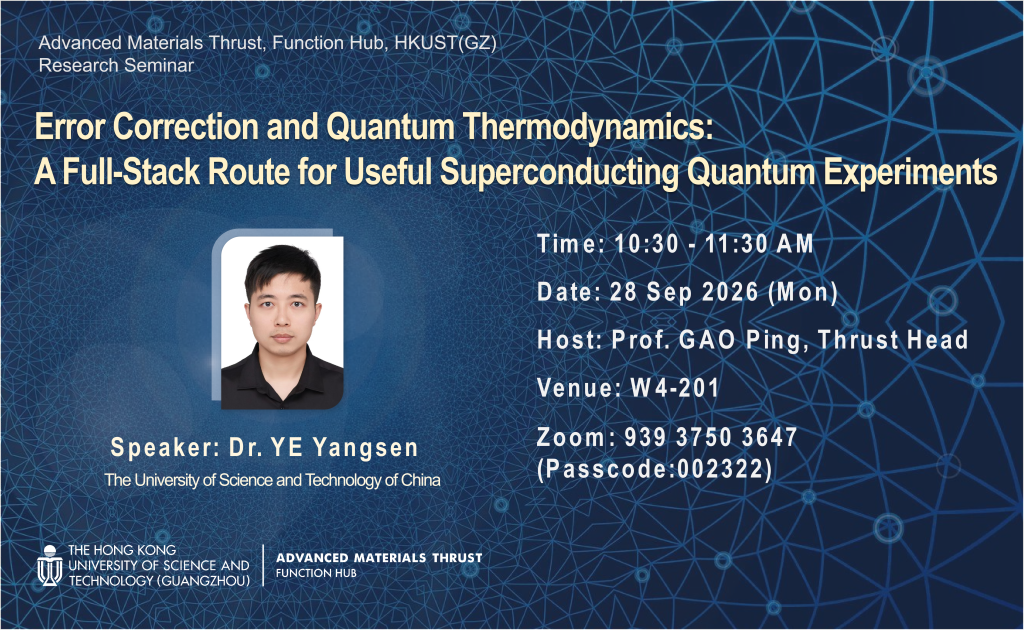
Time:
10:30 - 11:30
Date:
September 28, 2026
Location:
On Campus: W4-201; Online via Zoom: 939 3750 3647 (code: 002322)
Public Research Seminar - Error Correction and Quantum Thermodynamics: A Full-Stack Route for Useful Superconducting Quantum Experiments
Abstract
Quantum computing is moving beyond demonstrations of individual devices toward systems in which logical operations and scientific results can be verified. This transition requires more than increasing the qubit count: hardware architecture, calibration, error correction, algorithms, and physical interpretation must be designed together.
This seminar will present recent work on superconducting quantum processors from this full-stack perspective. It will first discuss tunable-coupler architectures and semi-automated calibration, which separate idle protection from fast entangling interactions and help maintain repeatable, high-fidelity control. It will then present experiments on repeated surface-code error correction and hardware-efficient logical magic-state preparation, highlighting what these experiments reveal about correlated errors, leakage, and logical resources.
The seminar will also introduce a quantum kernel-function expansion approach for finite-temperature quantum simulation and discuss experiments on transverse-field Ising and XY models, including error mitigation and internal consistency checks. It will conclude with an outlook on combining low-overhead quantum error correction with finite-temperature simulations of strongly correlated systems, including the Fermi-Hubbard model.
About the speaker
YE, Yangsen
Dr. Yangsen Ye is a researcher at the University of Science and Technology of China working on superconducting quantum computing. His research covers superconducting quantum chip architecture, high-fidelity quantum control, automated calibration, quantum error correction, and quantum simulation.
He has contributed to the development of tunable-coupler architectures and high-precision control on multi-qubit superconducting processors, repeated surface-code error correction, hardware-efficient logical magic-state preparation, and finite-temperature quantum simulation. His work has appeared in journals including Physical Review Letters and Chinese Physics Letters. Several of his papers have been selected as Editors' Suggestions. His current research focuses on connecting hardware design, control software, logical operations, and many-body physics to develop verifiable quantum experiments.