Time:
10:30 - 11:30
Date:
August 28, 2026
Location:
On Campus: W4-201
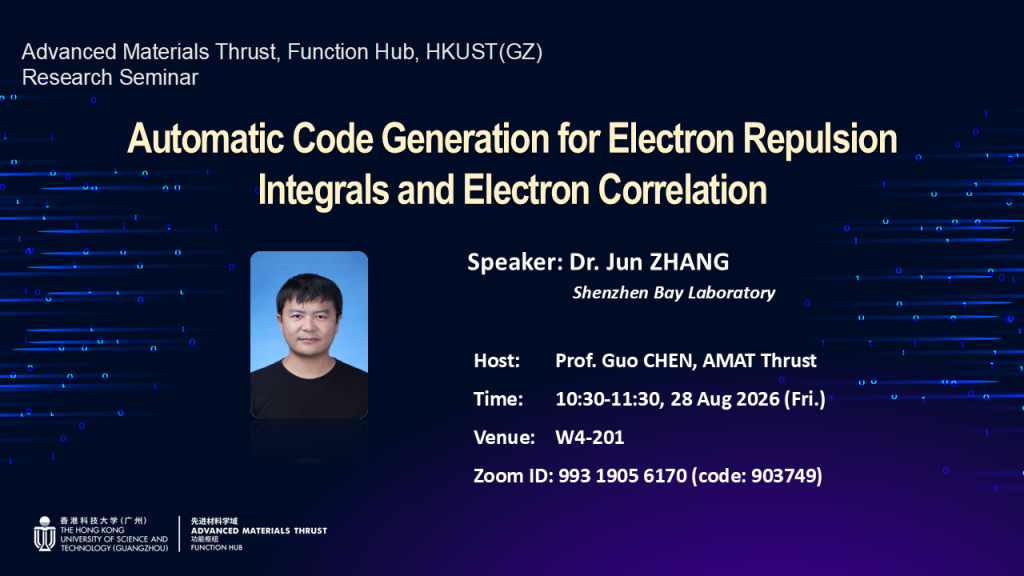
Public Research Seminar - Automatic Code Generation for Electron Repulsion Integrals and Electron Correlation
Abstract
Molecular integral calculation is the core bottleneck of ab initio electronic structure simulations. This work systematically optimizes Gaussian-type orbital (GTO) integral evaluation via vertical recurrence relations (VRR, including Dupuis-Rys-King (DRK) and Obara-Saika (OS)) and horizontal recurrence relations (HRR). We identify inherent redundant intermediate terms in OS-VRR computation graphs, while DRK’s compact two-index recurrence avoids such redundancy. A backtracking search strategy is proposed to build optimal computing graphs for all integral types and eliminate unused intermediates. Combined with early contraction separating exponent-independent HRR and exponent-dependent VRR, angular momentum terms are rearranged to shrink intermediate integral scales in advance. We further implement cache and memory optimizations to improve data locality, including tailored access patterns and memory reuse compression to lower cache miss costs. Based on these algorithms, we develop libreta, an open-source high-performance integral library supporting one/two-electron Coulomb integrals, multipole/pseudopotential integrals, Cartesian-spherical basis conversion, and their analytical derivatives. Libreta acts as the energy core of Qbics, a full-stack computational chemistry program integrating DFT, QM/MM, molecular mechanics, energy decomposition analysis and molecular dynamics. Qbics supports simulations from small inorganic clusters to million-atom biomolecules. This study establishes a complete optimization workflow for GTO integrals and provides open, high-performance tools for computational chemistry community. Furthermore, similar techniques have been applied to generated electron correlation codes.
About the Speaker
Jun ZHANG, Shenzhen Bay Laboratory
Jun Zhang received his PhD degree from the University of Cologne, Germany, in 2015 under the supervision of Professor Michael Dolg. From 2016, he conducted postdoctoral research in the group of So Hirata at the University of Illinois Urbana-Champaign, USA. He worked at the Pacific Northwest National Laboratory starting in 2019 and joined the Shenzhen Bay Laboratory in 2021. His research focuses on the method development and applications of theoretical and computational chemistry. In the field of chemical structure search, ABCluster developed by him has become one of the widely adopted tools for cluster structure prediction. In lanthanide chemistry, he theoretically predicted the phenomenon of "labile capping bonds" of lanthanide ions, which was later verified by experiments. For electronic structure theory, he has developed efficient algorithms for electron integrals and electrostatic potentials, targeted-state density functional theory for excited and diabatic states, many-body energy decomposition schemes, and incremental coupled-cluster methods. At the Shenzhen Bay Laboratory, he leads the development of the large-scale computational chemistry software Qbics and the visualization package Qbics-MolStar. To date, he has published more than 50 peer-reviewed articles with over 5,000 citations.