Time:
11:00 - 12:00
Date:
October 9, 2026
Location:
On Campus: W1-233; Zoom ID: 993 2920 1698 (code: 178768)
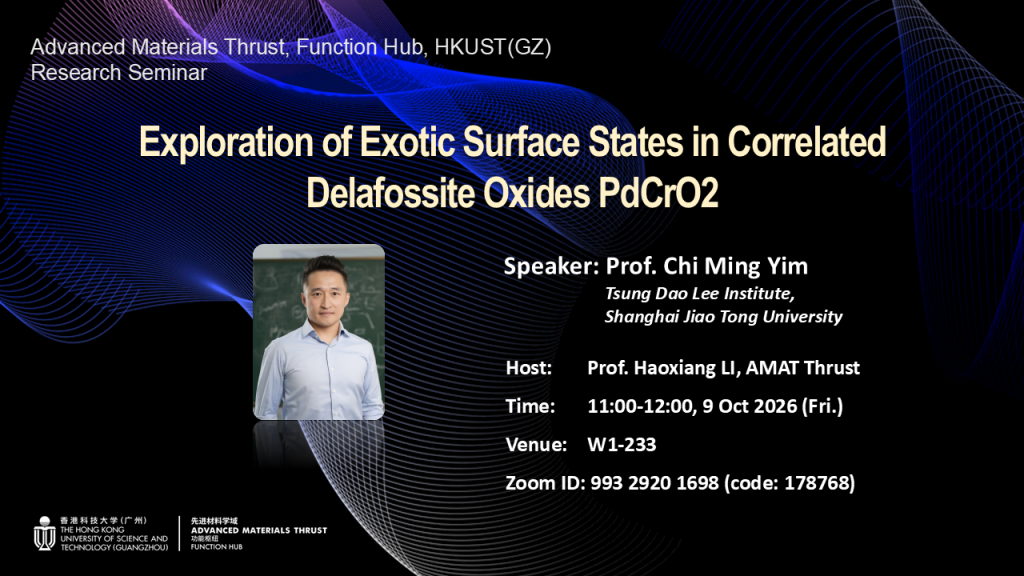
Public Research Seminar - Exploration of Exotic Surface States in Correlated Delafossite Oxides PdCrO2
Abstract
Delafossite oxides (ABO2) provide a unique platform for studying the interplay between itinerant electrons and strongly correlated quasiparticles, often yielding exotic surface states. Here, I present recent scanning tunnelling microscopy (STM) studies on the surface of PdCrO2, a bulk Mott-insulating antiferromagnet, revealing three distinct physical phenomena.
First, on the CrO2-terminated surface, we identify an unexpected charge-insulating state with short-range charge order [1]. This arises from surface hole doping inducing charge disproportionation, which splits the local magnetic moments and opens a charge gap—contradicting standard expectations for doped Mott surfaces.
Second, quasiparticle interference studies of the pristine Pd-terminated surface reveal surface states that are distinct from those in PdCoO2 [2]. Tight-binding calculations attribute this to enhanced inter-orbital hybridization, which drives stronger exchange splitting in PdCrO2.
Finally, by exposing the Pd-terminated surface to hydrogen, we observe the spontaneous formation of hydrogen clusters [3]. These clusters exhibit strong electronic localization and exceptionally sharp vibra- tional modes due to spatial confinement. Using a novel non-equilibrium IETS protocol, we determine that these H–Pd bond vibrations possess lifetimes of ∼100 ps—nearly two orders of magnitude longer than those on metal single crystals—highlighting the unique phonon damping environment of this delafossite surface [4].
References
[1] C. M. Yim et al. Avoided metallicity in a hole-doped Mott insulator on a triangular lattice. Nature Communications, 15(1):8098, September 2024.
[2] Y. Zheng et al. Exchange interaction at the Pd surface electronic bands in delafossite oxides PdCrO2 and PdCoO2. Journal of Physics: Condensed Matter, 38(17):175601, May 2026.
[3] C. M. Yim et al. Adsorbate-induced formation of a surface-polarity-driven nonperiodic superstructure. Communications Materials, 6(1):128, July 2025.
[4] C. M. Yim et al. Nonequilibrium effects in vibrational modes pumped by inelastic tunneling. Physical Review B, 114(10):105408, August 2026.
About the speaker
Chi Ming Yim
Prof. Chi Ming Yim is a tenure-track Associate Professor at the Tsung Dao Lee Institute, Shanghai Jiao Tong University. His research focuses on the ground-state properties of strongly correlated electronic materials and unconventional superconductivity, utilizing low-temperature scanning tunneling microscopy and spectroscopy (STM/STS). He received his Ph.D. from University College London (UK) in 2012. Prior to joining TDLI, Prof. Yim conducted postdoctoral research at UCL (2012–2016) and the University of St Andrews (2016–2020). To date, he has published 44 peer- reviewed papers in leading journals, including Science, Nature Communications, Science Advances, and Physical Review Letters.