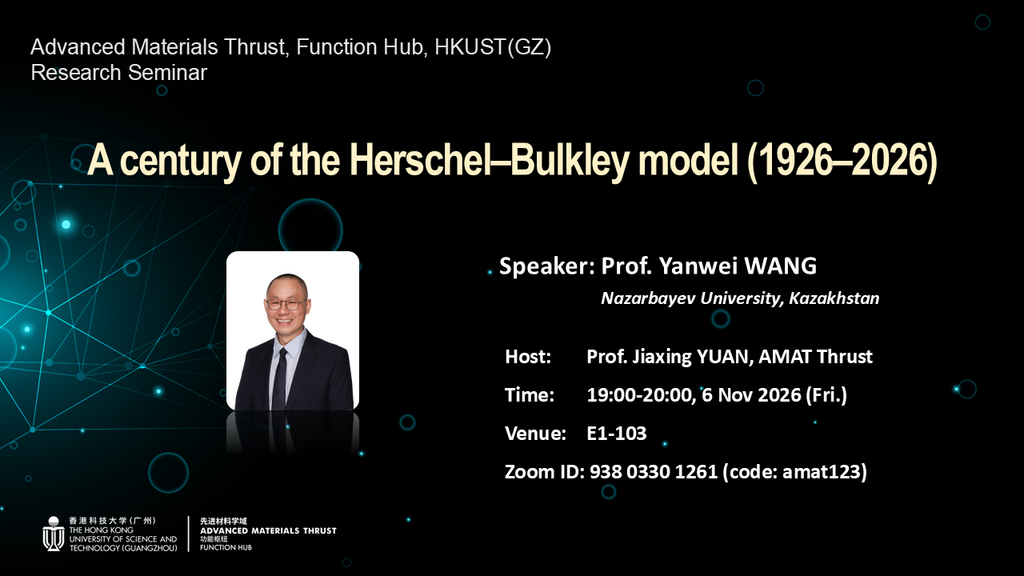
Time:
19:00 - 20:00
Date:
November 6, 2026
Location:
E1-103; Zoom ID: 938 0330 1261 (code: amat123)
Public Research Seminar - A century of the Herschel–Bulkley model (1926–2026)
Abstract
Introduced in 1926 to describe capillary-flow measurements of rubber solutions, the Herschel–Bulkley model has become a common constitutive description of yield-stress fluids. Its three parameters are used to characterize materials as diverse as drilling muds, fresh concrete, foods, foams, and printing inks. This seminar marks the model’s centenary by examining its historical origins, the community contributions that established its modern interpretation, and its predictive capabilities in engineering applications. The discussion connects rheometric measurements with constitutive theory, computational methods, and experimental validation. Particular attention is given to how material state, measurement protocol, wall slip, and the fitted shear-rate range influence the yield stress, consistency, and flow index. Examples involving pipe flow, particle motion and arrest, and free-surface spreading illustrate both the model’s strengths and the conditions under which additional physics is required. Thixotropy, elasticity, confinement, and nonlocal effects are considered in this context. The seminar concludes with practical lessons for characterizing yield-stress fluids and selecting, implementing, and validating constitutive models, together with open questions connecting soft-matter physics, materials processing, and engineering design.
About the speaker
Prof WANG, Yanwei, Nazarbayev University, Kazakhstan
Dr. Yanwei Wang is an Associate Professor of Chemical and Materials Engineering in the School of Engineering at Nazarbayev University, Kazakhstan. He also serves as Head of the Center of Digital Modelling and AI in Energy at the Institute of New Materials and Energy Technologies (INMET), and Acting Director of the Center for Energy and Advanced Materials Science at National Laboratory Astana. His research interests include computational science, multiscale modeling, soft matter, interfacial phenomena, and rheology. He combines theoretical analysis, numerical simulation, and data-driven methods to study complex fluids and functional materials, with applications in polymer rheology and processing, non-Newtonian and multiphase flows, and energy and environmental technologies.