Time:
11:00 - 12:00
Date:
November 23, 2026
Location:
On Campus: W2-101; Online via Zoom: 924 8958 0666 (code: amat123)
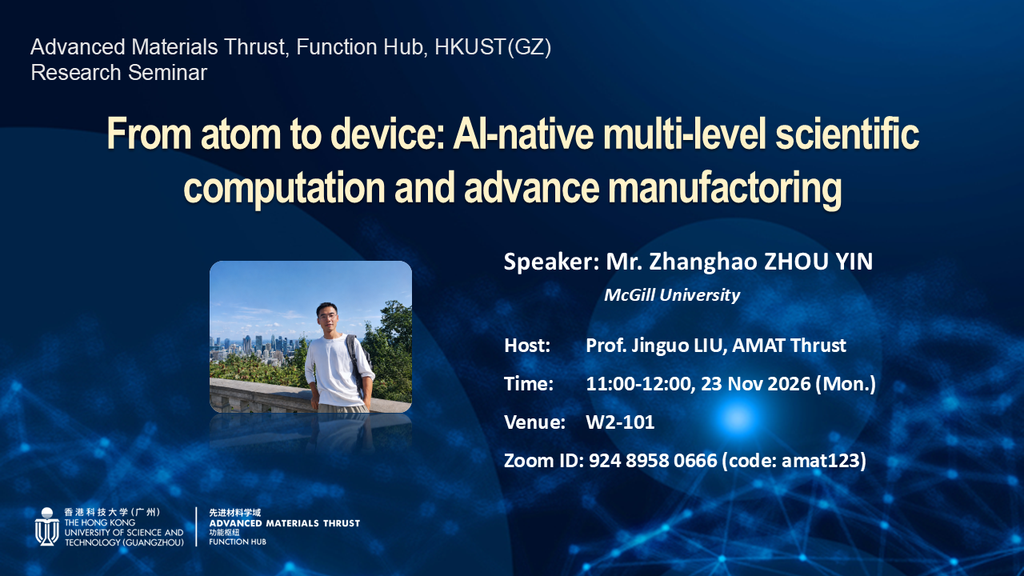
Public Research Seminar - From atom to device: AI-native multi-level scientific computation and advance manufactoring
Abstract
Advanced manufacturing is rapidly approaching the atomic scale. The performance of next-generation devices, including gate-all-around (GAA) transistors, complementary field-effect transistors (CFETs), and two-dimensional (2D) semiconductors, is increasingly governed by atomic-scale interfaces, defects, and quantum effects. Yet the development of realistic devices involves complex structures containing millions to tens of millions of atoms, as well as physical processes spanning multiple length scales. While first-principles calculations can accurately describe microscopic physics, they remain computationally prohibitive at engineering-relevant scales. Conversely, conventional device simulations can handle realistic device geometries but often struggle to capture and incorporate the underlying atomic-scale physics. How can we bridge the gap between accuracy and scale, enabling atomistic simulations to contribute directly to device prediction and engineering design?
This talk addresses this challenge through research advances across three interconnected levels. First, AI-native electronic structure methods, including DeePTB and SLEM, enable the efficient construction of electronic Hamiltonians from atomic configurations with near-first-principles accuracy, substantially reducing the computational cost of high-fidelity electronic structure simulations. Second, by combining VBCSR, a high-performance sparse computing library, with RSATB, a diagonalization-free framework for electronic property calculations, we extend simulations of the electronic density of states, local spectroscopic properties, optical response, and quantum transport to million-atom systems. These capabilities have enabled the reproduction of key experimental observations in a supermoiré system containing approximately 450,000 atoms. Third, integrating quantum transport and multiscale device simulation, we explore how atomic-scale physics associated with materials, contacts, and defects can be transferred into continuum TCAD and process models, establishing verifiable multiscale interfaces between microscopic physics and engineering design.
Together, these efforts aim not only to extend the physical scales accessible to high-fidelity scientific computing, but also to advance a new paradigm for device research and development: transforming atomistic simulation from a tool for interpreting experiments into a predictive framework for evaluating performance and optimizing devices, ultimately making high-fidelity physics-based simulation a foundational capability for next-generation semiconductor, optoelectronic, and quantum hardware development.
About the Speaker
Mr. Zhanghao ZHOU YIN, McGill University
Zhanghao Zhouyin is a Ph.D. candidate in Physics at McGill University, supervised by Professor Hong Guo. With interdisciplinary training in computer science, electronic and information engineering, and physics, his research lies at the intersection of artificial intelligence and computational physics, spanning AI-driven first-principles electronic structure methods, large-scale atomistic simulations, high-performance scientific computing, and multiscale device modeling.
He has conducted research and development at the Beijing Academy of Artificial Intelligence (BAAI), the AI for Science Institute, Beijing (AISI), and Nanoacademic Technologies, and is a recipient of the Leong Fellowship in Science at McGill University.
As a core developer of DeePTB and co-first author of its corresponding Nature Communications paper, he contributed to the development of high-accuracy machine-learning approaches to electronic structure calculations. He subsequently introduced SLEM, a strictly local equivariant framework for learning electronic Hamiltonians (ICLR 2025 Spotlight), and further developed VBCSR, a high-performance sparse computing library, and RSATB, a scalable framework for electronic property calculations, extending atomistic Hamiltonian-based electronic simulations to systems containing millions of atoms.
His research has been published in leading international journals and conferences, including Nature Communications, ICLR, and Physical Review B. His current work focuses on developing AI-driven multiscale computational methods that bridge atomistic electronic structure and realistic devices, with the goal of bringing high-fidelity physics simulations into the research and development of next-generation semiconductors, optoelectronic materials, and quantum devices.